Riddle School Series in Order: All Five Games and Both Riddle Transfers
Published · 3 min read
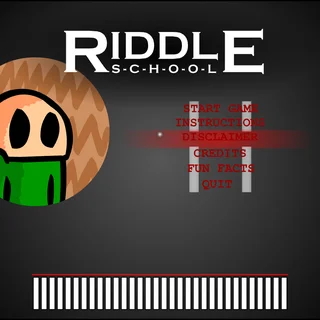
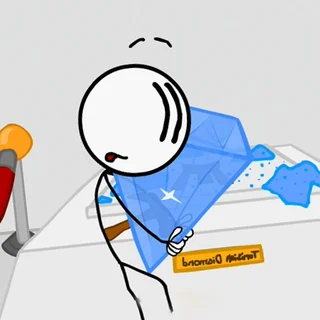
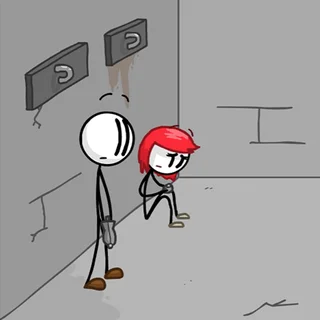
Riddle School is not one game but seven: five numbered Riddle Schools and two Riddle Transfers, all by the same author. He signs the early ones JonBro and the later ones Jonochrome. All seven are on this site, running from their original Flash files on Ruffle. This is the order to play them in, and what changes along the way.
1. Riddle School
The first game is the smallest. Its canvas is 550 by 400 pixels. According to its own Fun Facts screen it took three weeks to make and uses 99 library items and seven characters. Phil escapes Mister Kahm's maths class, gets past Richy the hall guard and tries to leave the building. It introduces everything the series keeps: click a balloon to advance, click an item to collect it, click it in the inventory to use it. Pressing any key restarts it, so play with the mouse only.
2. Riddle School 2
Riddle School 2 keeps the same dark title screen and Main Menu button, and widens the picture to 700 by 400. The rules have not changed: click balloons, click scenery, collect items and use them from the inventory. That makes it a good second game, because the puzzles expect you to have learnt those habits.
3. Riddle School 3
Riddle School 3 grows again, to 700 by 475, with a new sunburst title screen. It is also the first of the series built for Flash 8 instead of Flash 7, which is why its art and animation look a step up from the first two.
4. Riddle School 4
Riddle School 4 switches to a 640 by 480 canvas and a new logo with the number in chrome. From here on, all the Riddle Schools run at 30 frames per second, where the first three ran at 24.
5. Riddle School 5
Riddle School 5 is the last numbered game. Its file is about twice the size of number 4 and more than twenty times the size of the first. Its ending leads into the Transfers, so play the others first.
6. Riddle Transfer
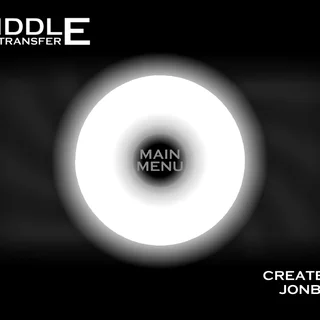
Riddle Transfer continues the story after Riddle School 5 under a new name. Its main menu is a glowing ring with the words Main Menu in the middle, and its credits run long: the file links to more than thirty Newgrounds pages of artists and musicians. The puzzles work the same way.
7. Riddle Transfer 2
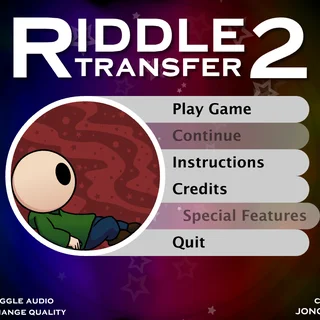
Riddle Transfer 2 is the finale, from 2016. It opens with a note from its author: it had been five years since he scrapped his original plans for the game, he wanted to give the story closure, and this sequel has no cliffhanger. It is the largest of the seven, both in file size and in canvas (800 by 600). Its menu adds a Continue button, so you can pick up where you left off, and Special Features. Its instructions are one line: it is a point-and-click adventure game, and you can combine certain items. Two key shortcuts are printed on the menu: A+X toggles audio, and Q+X changes quality.
Do you have to play them in order?
Each game stands on its own as a puzzle, but the story does not. Characters come back, and the endings lead into the next game. That matters most from Riddle School 5 onward. If you are short on time, play 1 to get the idea, then go straight through 5 and both Transfers.
A few things that hold for every game
- Click inside the game once before playing so it has focus, and keep your hands off the keyboard in the early games.
- If a puzzle stalls, walk back through every room and click everything again. New items make old scenery useful.
- Each game has a Credits screen worth opening at least once. These games were made by one person with help on the music, and the credits say who.
Stuck at the start of the first game? The opening walkthrough gets you from Mister Kahm's class to Richy the hall guard.
More from the blog
- Riddle School Walkthrough: Getting Out of Mister Kahm's Class
The menu, the one rule that restarts your game, the pencil sharpener, the corridor rooms and Richy the hall guard: the opening of Riddle School step by step.